LORD TRIPURANTAKA AND GODDESS TRIPURASUNDARI OF KODUMBALUR
Kodumbalur, a hamlet in Pudukkottai district, Tamil Nadu, is about 46kms from the district headquarters Pudukkottai and about 35kms from Tiruchirappalli. The village is renowned for its ancientness, being capital city of the Irukkuvel kingdom, credited with two ancient temples viz., Moovar Koil and Muchukundeswara temple. The antiquity of the village can be traced back to very ancient period, Silapathigaram mentions the place as Kodumbai, a glorious capital of Irukkuvels, located on the banks of a large tank and lying enroute of Uraiyur, the capital of Cholas and Madurai, the capital of Pandyas. Inscriptions of these temples mentions the village as Kodumbalur or Kodumbai in Urattur kurram and later under the administrative division of Konadu. Moovarkoil, an architectural splendour of the Irukkuvel dynasty, probably was a big temple complex with three main shrines and sub-shrines for parivara deities encircling. The sculptures of Moovarkoil are master-pieces of early art. Lord Tripurantaka and Goddess Tripurasundari are the two sculptures of Kodumbalur is at present preserved in Madras Museum. Both the deities are depicted as bas-relief sculptures.
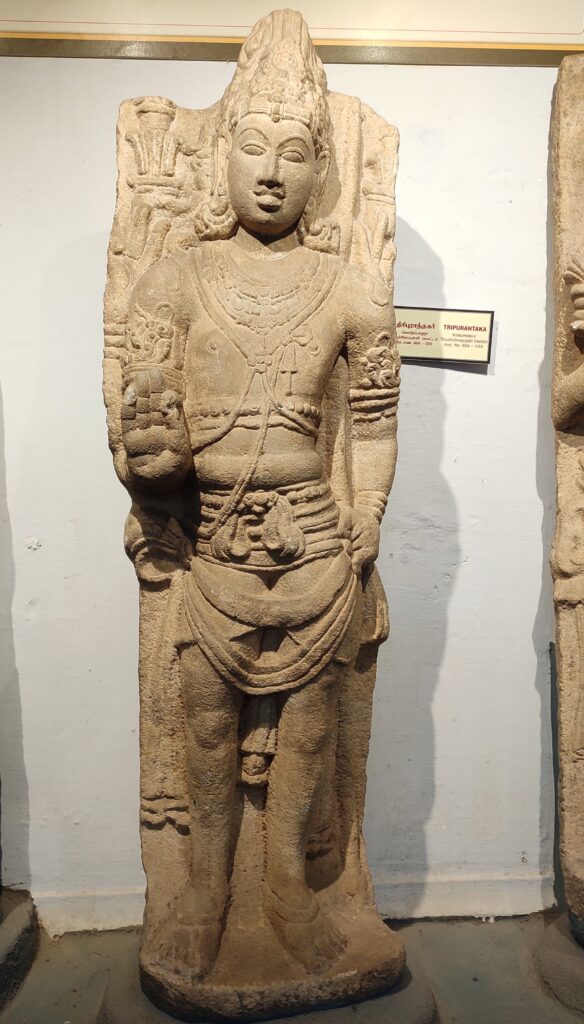
Lord Tripurantaka is standing on a pitha with his left leg in sama while the right leg is in parsva. The back hands are in kartari mudra, whereas the front right hand is in chin mudra and the front left hand in kataka is placed near the hip holding the bow that is held behind Him. A long bow extending to the height of head to foot is seen resting on the floor of the pitha. Behind the God on both sides apron is seen with arrows in it.
The braids are gathered and beautifully matted as jatamakuta, and decked with ornamental head patta and makarapurimam. Crescent moon adorns the left side and the excess locks that spread in the shoulders adds beauty. The God is draped in marauri adai and fastened by hip belt, the excess noose of the belt is bow knotted in the front. The idaikattu is slackly worn above the attire for which knots are heavily shown on both side and dangle upto the calf.
The ears are elongated and decked with makarakundalas, stone studded charapali with hangings and ornamental chavadi adorns the neck. As like, stone studded udarabandha is seen around the abdomen. Both chhannavira and Yajñōpavita are adorn by the God, chhannavira the symbol of warrior has a broach in the chest. Yajñōpavita is worn in upavita fashion, has brahmasutra in the chest. The arms are decked with kankanas and ornamental keyura and thazhseri adorn the ankles. The God in tall and slim stature, lavishly decked with ornaments, carrying the bow and arrow, and the slight grin all exhibit Him as a composed warrior.
Lord Thiripuranthaka as koshtha deity is also seen in the southern koshtha of vimana at Thirukattalai in Pudukkottai district.
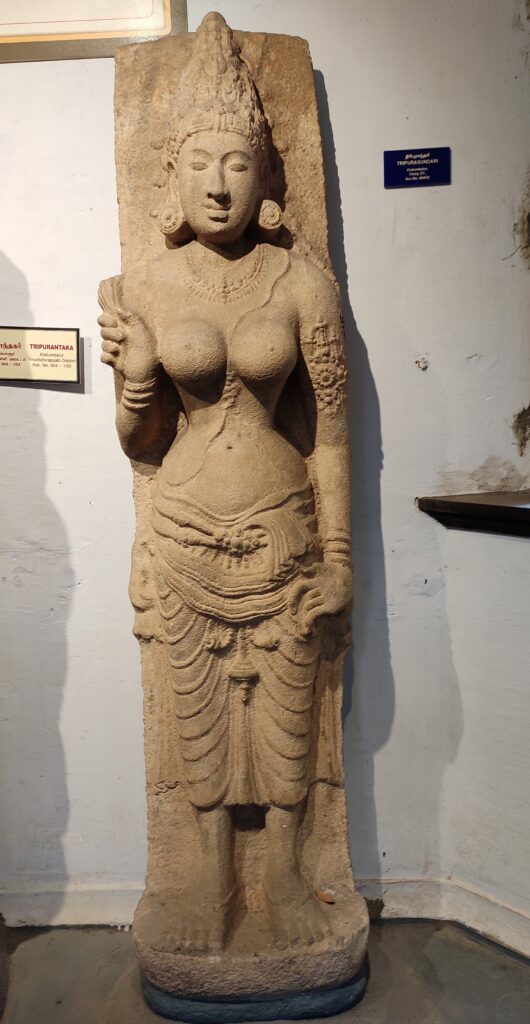
Goddess Tiripurasundari shown as a bas-relief sculpture is standing in sama on the pitha with right hand folded up and in kataka is holding the sugarcane whereas the left hand is stretched down and in katyavalambita. The Goddess is decked in karantamakuta, head patta with ornamental patrapurima in the front and sides, excess braids from the makuta flow on the left shoulder. The Goddess is draped in a well creased long attire extending upto the calf, in addition frills (mun kosuvam) are shown in the front. The heavy crease in the attire denotes it as silk drapery and above the silk attire idaikattu is slackly worn, for which heavy knots dangle on sides. However, breast band is absent. The yajñōpavita is a thin thread, worn in upavita fashion for which the brahma knots are shown below the breast. The Goddess is lavishly decked with ornaments; elongated ears are decked with stone studded patrakundalas, ornamental stone studded charapali is worn around the neck, arms are decked with kankanas and keyura, as like, thazlseri in the ankle. Above the silk attire, megalai is worn and it has a stone studded broach in the middle with beaded hangings and bell hangings. The perfect anatomy, calm and serene look, lavishly decked in ornaments, the Goddess seems a perfect blend of beauty and divinity.
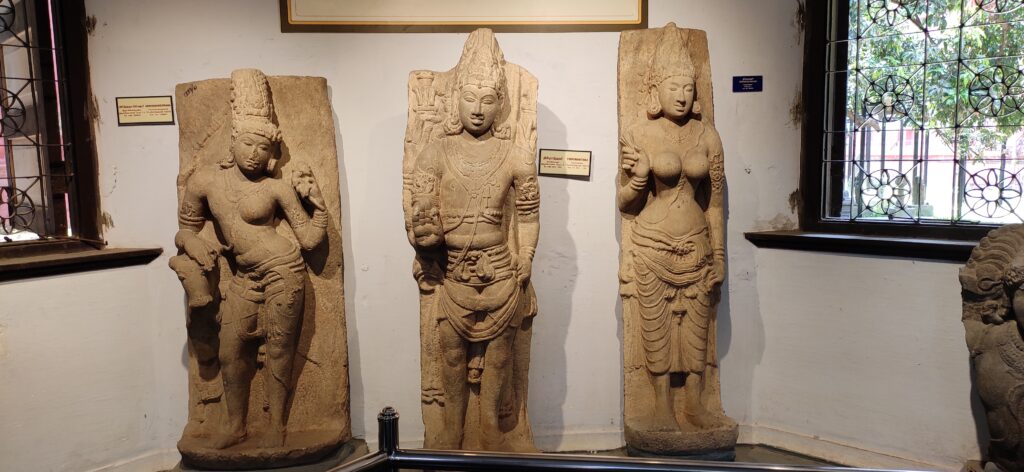
Both Lord Tripurantaka and Goddess Tripurasundari at Madras Museum are masterpieces; perfect anatomy, lavish in attire and ornaments, tranquil and serene in look, create a perfect blend of beauty and divinity. These two sculptures in all its facets carry the traits of the sculptures at Moovarkoil, perhaps, the remnant of the third dilapidated temple.