Allur, a hamlet on the southern banks of the river Cauvery is twelve kilometers from the city Thiruchirappalli, lying en-route of Thiruchirappalli-Karur highways. The village is credited with two Chola temples named Pasupathiswara and Panchanadeswara, the former inside the village and the latter at the entry point of the village adjacent to the NH 81. Though Allur at present a single village, during the Chola period it was two villages namely, Allur and Thiruvadakudi. The inscriptions at Pasupathiswara temple mention the deity and village as Allur and Allur Nakkarkoil Parameswara respectively whereas the inscriptions at Panchanadeswara temple mention Thiruvadakudi Mahadevar and Thiruvadakudi, a devadana neighbourhood of Allur. The former was administered by Ur while the latter was by Sabha. Both the villages were under the administrative division of Uraiyur kurram and after the reorganization of territories in the Middle Chola period, Uraiyur Kurram came under Keralanthaga valanadu.
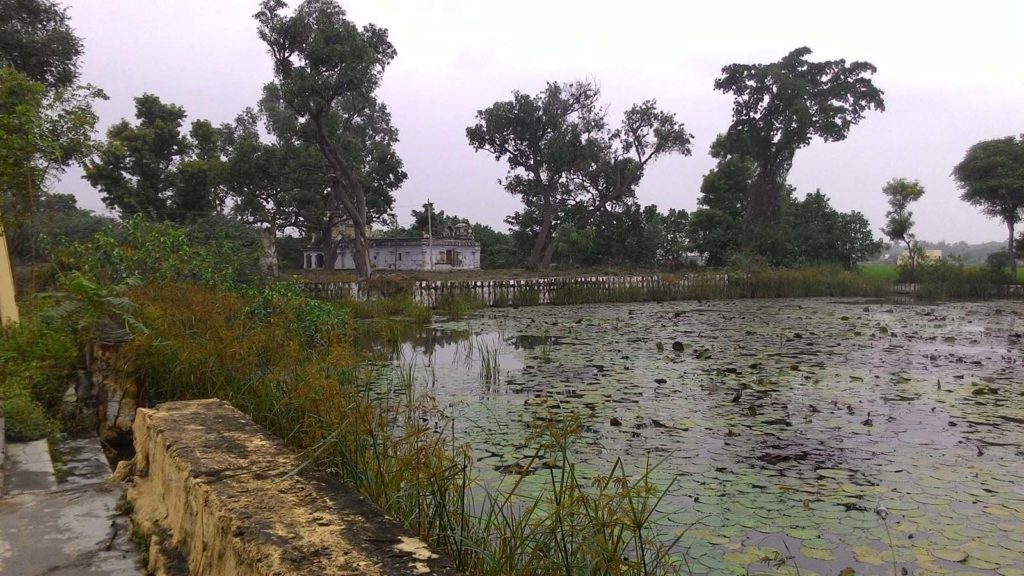
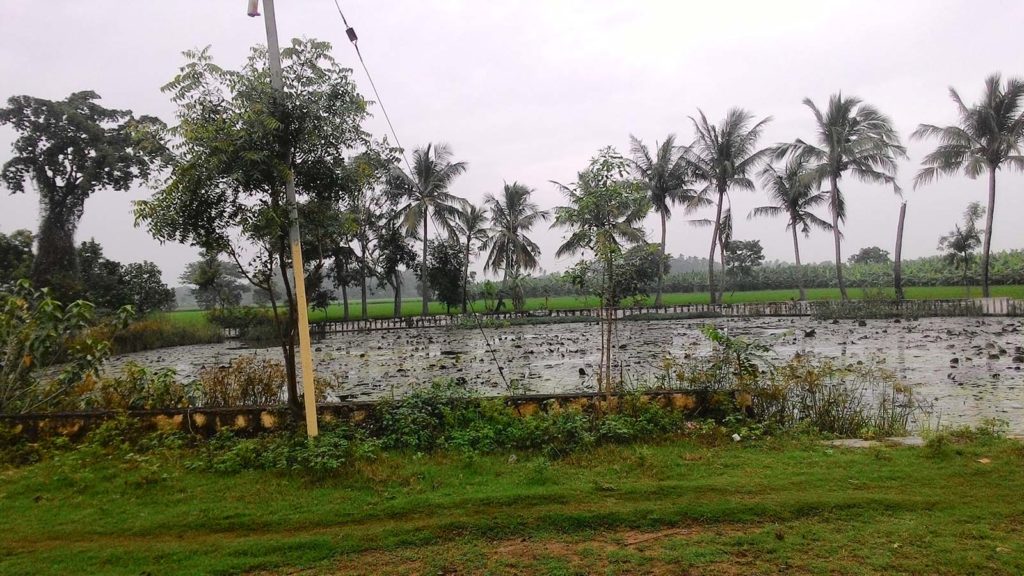
A road that cut towards south from the NH 81 at Allur leads us to the residential quarters of the village, wherein the end of the dwellings, the green carpet passage welcomes us to the Allur Nakkarkoil. No one can get away without comprehending its awestruck environment; surrounded by lush green fields, huge trees, lily filled pond, a temple of the folk deity in the nearby, reminds us a period film location. In all its solitude Allur Nakkar koil stands in the midst of this tranquil setup.
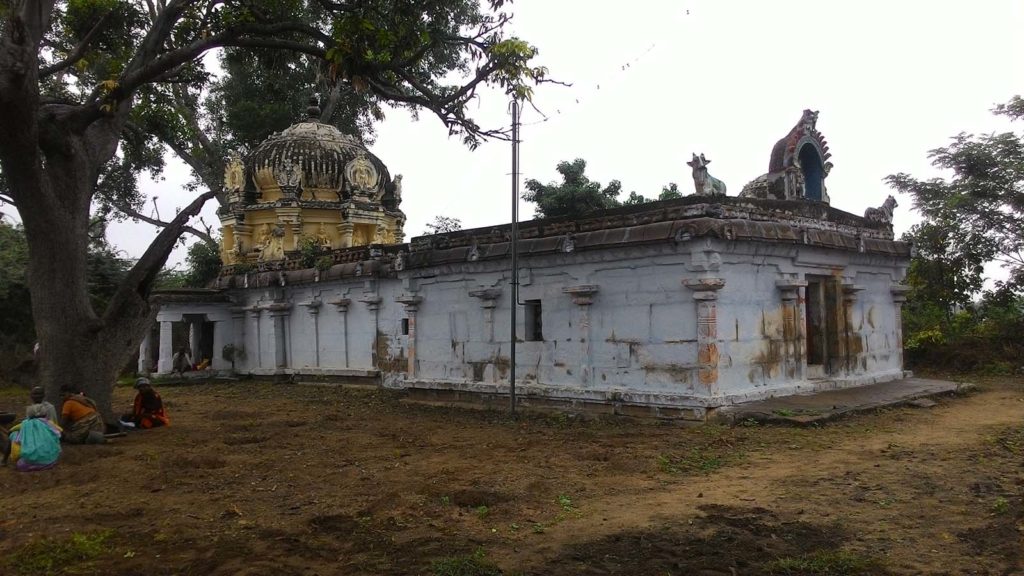
Nakkarkoil consists of a vimana, mukha mandapa and a maha mandapa facing east. The temple lies in the open space, closed enclosure and gopura are absent for the temple. A shrine for the goddess is seen on the northern side of the maha mandapa facing south.
THE VIMANA
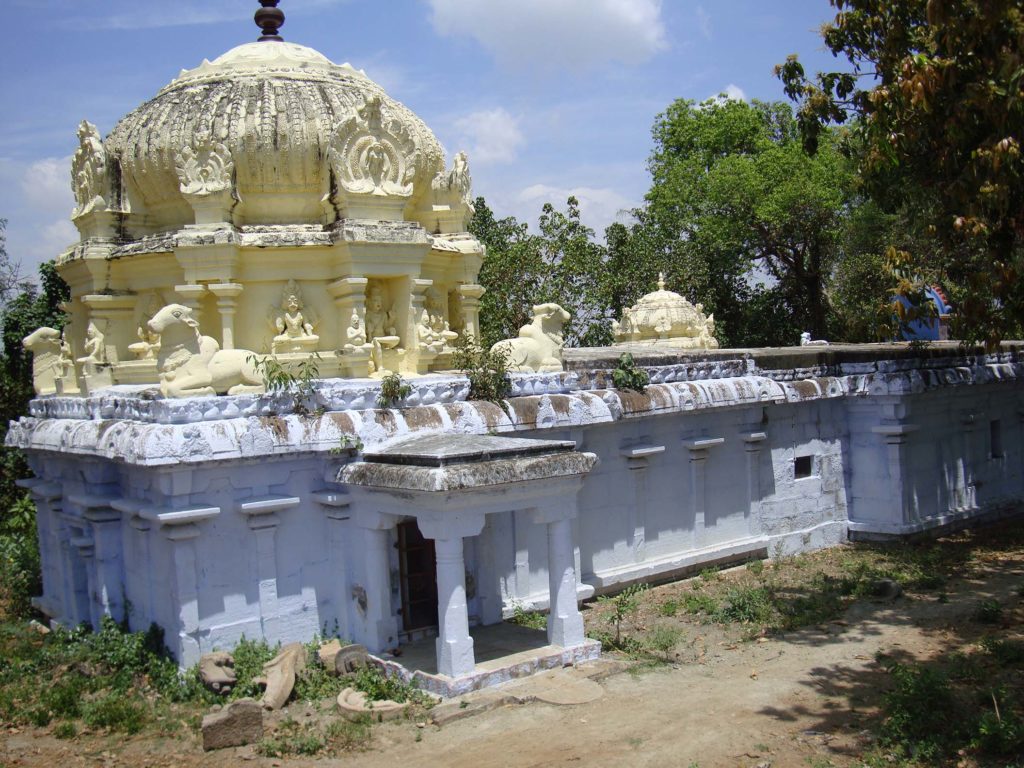
The vimana is a mixed ekatala vimana with dravida tala and crowned with vesara sikhara. It has an adhishthana, bhitti, prastara, griva, sikhara and stupi. The vimana is segmented as karna-bhadra-karna and the segments are demarcated by a pair of pilasters each. In addition, the bhadra section is projected a little and decked with a koshtha in the middle. The adhishthana is padabandha type with octagonal kumuda. Above the pattika runs a thin vajana. The bhitti that raise above the adhishthana is cantoned by brahmakantha pilasters, each segment is represented with a pair of pilasters. The brahmakantha pilasters possess head components of kattu, kalasa, tadi, kumbha, pali, phalaka and virakantha.
The potikas that rests above the pilasters are plain-angular that extend its limbs to bear the uttira and above the uttira runs the thin vajana followed by valabhi. Valabhi is decked with bhuta series. The roof of the tala extends as flexed overhanging kapota. The kapota is decked with kudu arches at frequent intervals, chandramandalas at ridges, ornamental scrolls at the corners. Above the kapota is the bhumidesa represented with yazhi frieze, makara heads adorn the corners of the bhumidesa. Above the bhumidesa, little inside, rest the vedica complex on which lies the vesara sikhara.
The sikhara is refurbished with cement plastering on outer side. The griva of the sikhara is decked with maha nasikas in the cardinal directions and also adorned with deities of cardinal directions. In between the maha nasikas, alpa nasikas are shown, but are empty. The spaces in between the nasikas in the griva are adorned with dikpalas. Above the aditala, Nandi is seen placed at the four corners. Pranala is shown on the northern side of the vimana at pattika level.
THE KOSHTHAS
The projected bhadras on the north, south and west are adorned with koshthas. The koshthas are flanked by brahmakantha split pilasters and crowned with makara thorana. The pilasters possess the same features as like the pilasters of the bhitti and the makarathoranas are with shallow ornamentation. The koshthas in the north and west are empty whereas Lord Dakshinamurti housed in the southern koshtha. The traits of the sculpture bring to the forefront the period as recent origin.
A small mandapa is established in front of the Dakshinamurti koshtha, the mandapa is supported by a pair of pillars and pilasters. The pillars and pilasters have a square base and the shaft that raise above that is ornamented as vishnukantha, indrakantha and rudrakantha types and also with head components are shown. Above the kalasa rests the vettu-taranga potikas, extending its limbs to bear the prastara. The roof of the mandapa is finished with cement plastering. The mandapa might have constructed in late 12 th or 13 th centuries C.E.
On the northern koshtha, female bas-relief sculptures are shown on either side of the koshtha. Both the damsels are draped in long attire, idaikattu and adorned with ornaments like patrakundalas, charapali, chavadi, kankanas, keyura, thazlseri. Their locks are gathered and styled as dammilam and also decked with flowers. Both carry flower in their right hand which is in kataka while the damsel on the east is showing vismaya on her left hand, the damsel in the west has placed her left hand near her abdomen. Besides, three pots are piled up on a stand near the damsel in the west. Both the bas-relief sculptures might be of later origin and not belonged to the period of the vimana.
THE MUKHA MANDAPA
The mukha mandapa possess the same features of the aditala of the vimana viz., padabandha adhishthana, bhitti cantoned by brahmakantha pilasters and prastara with all usual elements. The bhitti is cantoned by four brahmakantha pilasters on the north, south and east. The spaces in between the pilasters on the north and south are plain whereas in the east, the space in between the middle pilasters forms the doorway to the mukha mandapa and niches are formed in the spaces on either side, dvarapalas housed in the niches.
THE MAHA MANDAPA
In between the mukha mandapa and the maha mandapa, a passage is seen. The passage has plain walls on the north and south that adjoins the mandapas on both sides. The walls are plain but flexed overhanging kapota and bhumidesa of mukha mandapa also continues for the passage.
The maha mandapa possess the same features of the mukha mandapa viz., padabandha adhishthana, bhitti cantoned by brahmakantha pilasters and the prastara with all usual elements. Four brahmakantha pilasters canton the maha mandapa on the north, south and east, the pilasters possess same features as like the pilasters of the mukha mandapa. The doorway to the mandapa is on the east formed in between the middle two pilasters, besides; the doorway is also flanked by plain brahmakantha pilasters. The potikas of the maha mandapa are also plain-angular that bears the usual prastara elements. The valabhi is adorned with bhuta frieze and the kapota is ornamented with kudu arches, chandramandalas and kodikarukku. Bhumidesa is shown above the roof of the maha mandapa, it is interesting to see a pair of elephant in the series on the southern side. The roof of the mandapa is refurbished with cement plastering, besides, Nandi at the corners and a niche above the entrance are shown. Umasahita seated on rishaba housed in the niche. The doorway has ornamental door frames, the jambs are ornamented with nagabandas and big padma series.
INSIDE
The maha mandapa is a pillared hall with two rows of two pillars each. The pillars are segmented as three squares and kattu in between, the squares are plain. The potikas are also plain-angular as like the pilasters of the vimana and mandapas. The potikas bear the prastara of the mandapa, the roof of the mandapa is covered with stone slabs.
The shrine of the goddess is seen on the northern side, Nandi is seen placed in the centre of the mandapa facing the sanctum, besides, Ganesa, Muruga, Bikshadana, Chandeswara, Surya and a male devotee are seen placed on the platforms forme in the corners of the mandapa. Among the deities placed in the maha mandapa, Bikshadana is a remarkable sculpture and undoubtedly belongs to Early Chola period.
The doorway on the east leads to the passage which in turn leads to the mukha mandapa. Dvarapalas flank the entrance, besides, the doorframe of the mukha mandapa is also ornamented with lush leafy embellishment. The mukha mandapa has four pillars, ornamented as square-kattu-square as like the maha mandapa but the potikas that rests above the pilasters are vettu type. It is quite interesting to see the vettu potikas inside the mukha mandapa while the potikas of mukha mandapa and maha mandapa bhitti, maha mandapa inside are plain angular. It denotes refurbishment of the mukha mandapa in the later period. The potikas bear the prastara elements.
The sanctum is a cubical chamber, the bhitti of the sanctum is plain but has the prastara elements of uttira, vajana and plain valabhi. The sanctum houses Lord Nakkarkoil Parameswara in the form of Linga, the vesara avudaiyar is ornamented as padma and the gomukha is shown facing north.
THE GODDESS SHRINE
The goddess shrine on the northern side of the maha mandapa has upapitha, plain bhitti, prastara and crowned with newly constructed vesara sikhara. In the sanctum the goddess is standing in sama on a padmapith with her backhands carrying lotus and her front hands are in abhaya and varada. In jatamakuta and long attire, the deity is also decked with all usual ornaments.
SCULPTURES
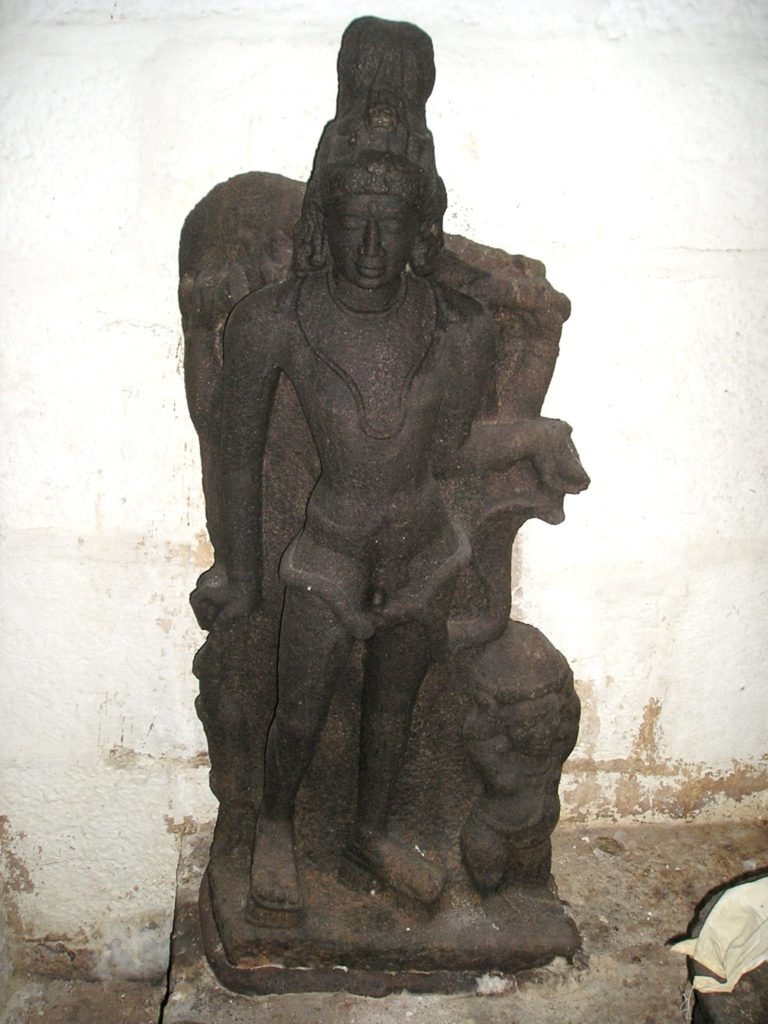
Bikshadana
The Supreme Mendicant in nude posture is in walking pace; his left leg firmly plant on the floor of the pitha while his right leg slightly bend at knees showing he is on the move. The back hands in kataka carry damru in the right and the kankala-danda in the left. His front right hand is also in kataka and feeding the deer whereas his front left hand carries the scull bowl. His braids are gathered as heavy jatamakuta and decked with skull and head patta. The elongated ears are decked with makarakundala in the right and patrakundala in the left. Kandigai and a long beaded mala are worn in the neck, beaded kankanas in the arms. Yajnopavita is worn in upavita fashion, besides, a snake is entwining his lower body with hood raised on the left. The deity is wearing wooden sandals in the foot. To the left of the God a gana is carrying the mendicancy bowl on his head. In short attire and yajnopavita the gana is also decked with ornaments like patrakundalas, beaded mala and kankanas. In a elaborate smile he is carrying the filled mendicancy bowl holding with his hands. To his right is seen a deer pouncing for the feed given by the God.
Dvarapalas
Both the dvarapalas are standing in dvibangha posture with their lower body twisted sideways and the upper body facing straight. One of their leg is planted on the floor of the niche and their other leg is lifted up and placed on the plank held by them. The dvarapala on the south lifted his right leg up and placed on the tree branch held by him whereas the dvarapala on the north lifted his left leg and placed on the mace held by him. Both the dvarapalas have placed their other leg in parsva.
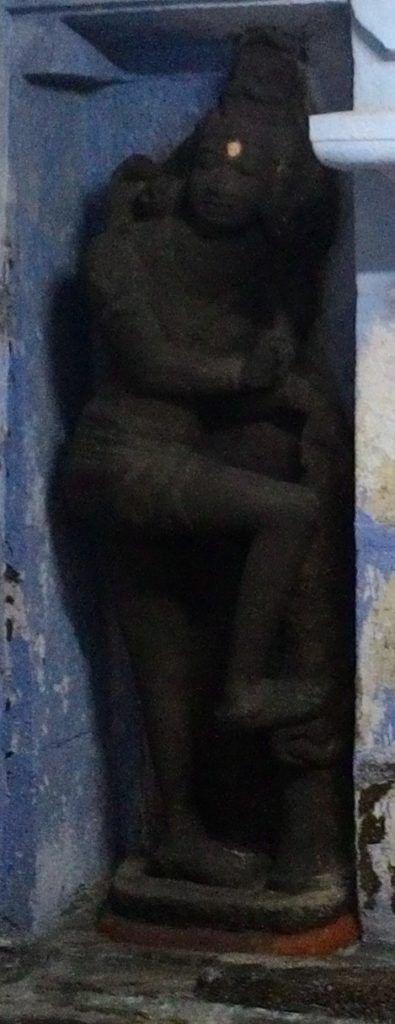
Both are draped in short attire fastened by araipattigai and the idaikattu is slackly worn above it. Karandamakuta adorns the head and the excess locks from the makuta spread in their shoulders. Both are decked with head patta, owl kundalas in their elongated ears, stone studded charapali and chavadi adorn their neck, udarabanda in the abdomen. Kankanas, kirtimukha keyura and heavily beaded anklets are the other ornaments worn by them. Such anklet is also seen in the dvarapalas of Thirunedungalam. Yajnopavita is worn in upavita fashion.
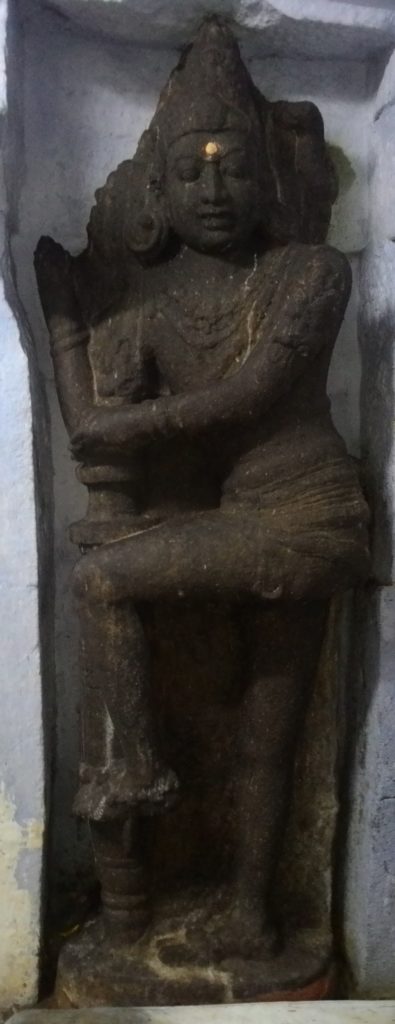
The southern dvarapala is holding a heavy tree branch on the left hand while his right hand is in darjani, whereas his counterpart is holding the mace on the left hand and his right hand is in vismaya. A snake is shown emerging out of a hole and entwining the branch. Besides, for both the dvarapalas snake with raised hood is shown in the shoulder. Both the dvarapalas with raised eyebrows, spewed out eyes and sharp fangs are in a slight grin even in their daunting look.
Devotee
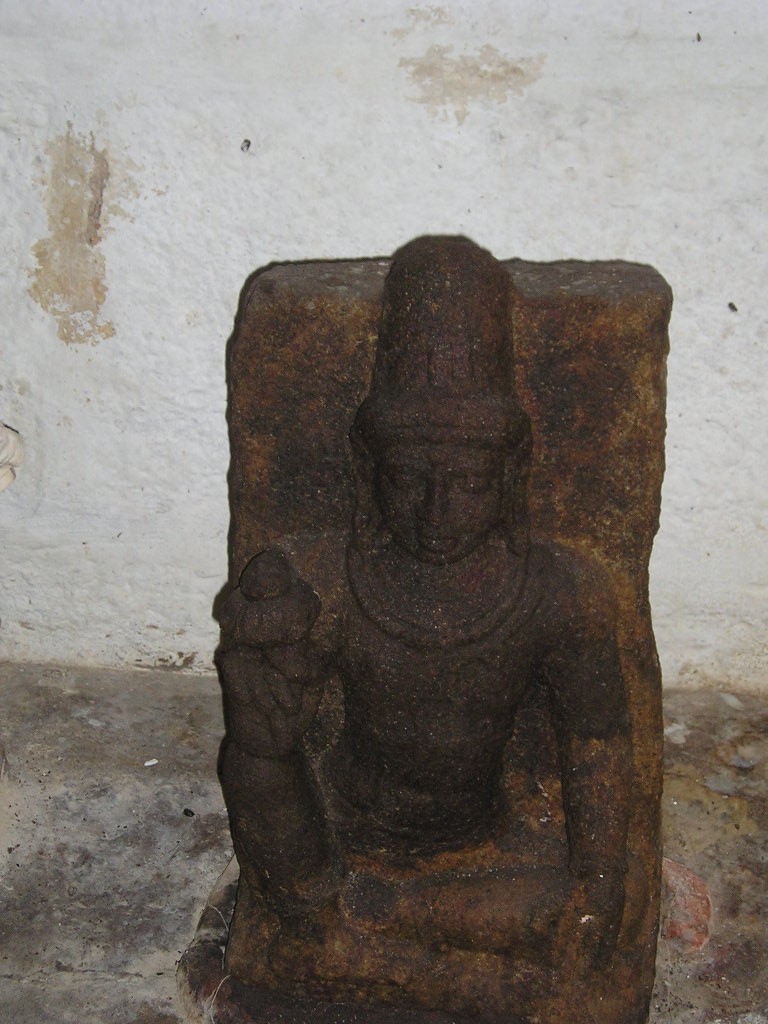
A devout male in jatamakuta and chenni is seated in suhasana on a pedestal with his right hand in kataka and holding a flower whereas his left hand is resting on his left leg. In broad smile, he is clad in long attire and decked with ornaments like kandigai, chavadi, kankanas, keyura, udarabanda and pootukundala in elongated lobes. A thick yajnopavita is worn in upavita fashion. Specific objects of identification are absent, the other attributes of the sculpture denotes him a pious devotee.
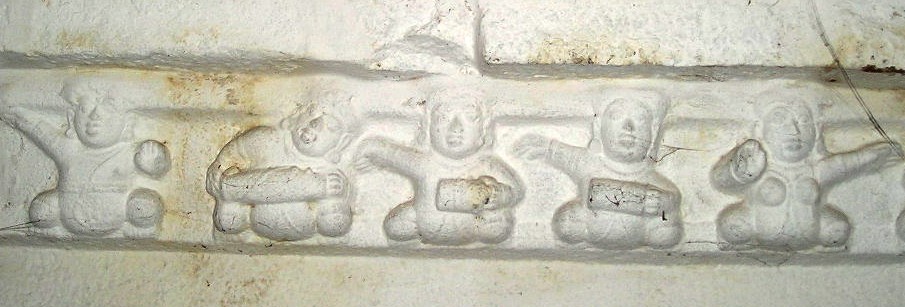
BHUTA FRIEZE
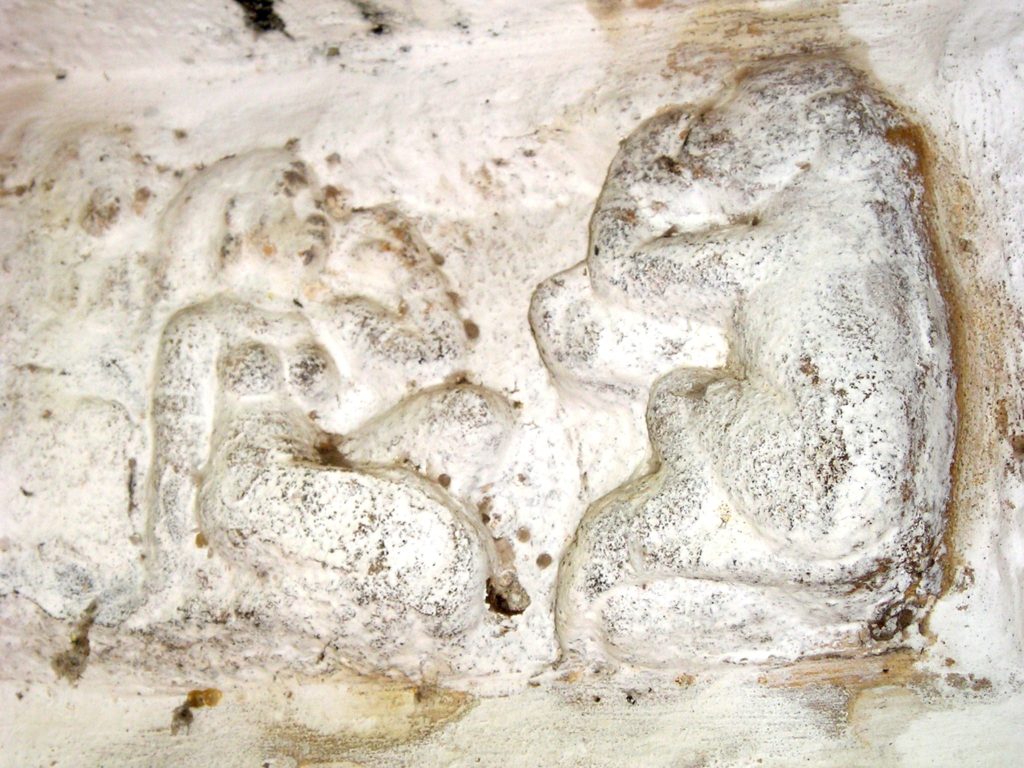
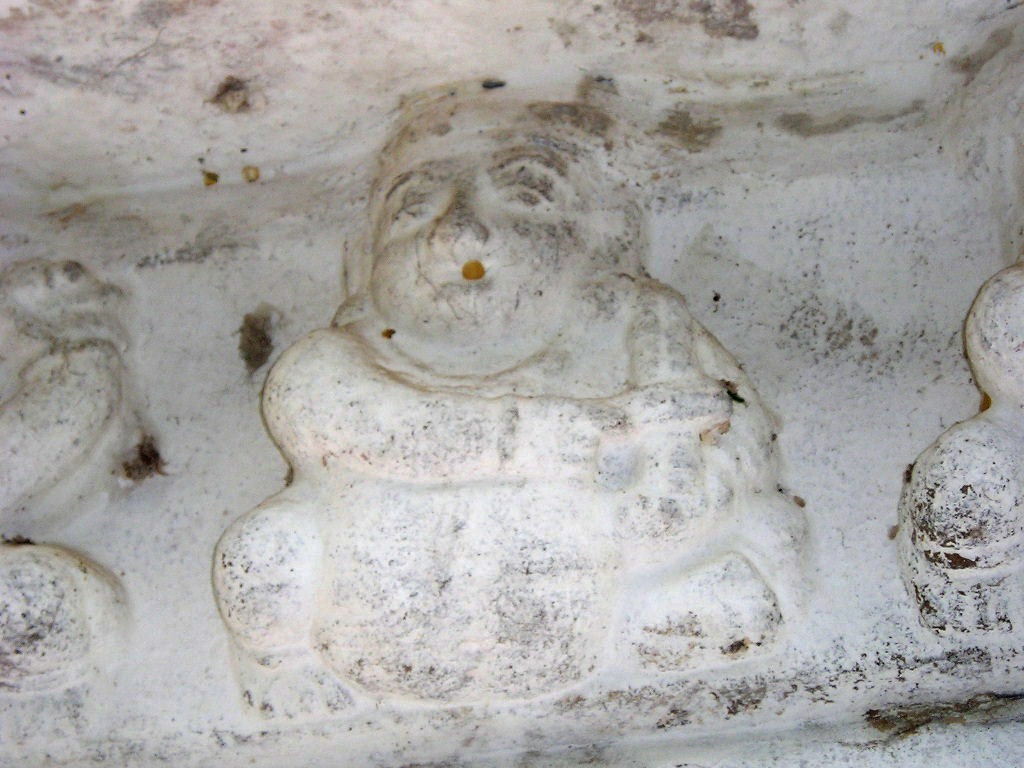
The valabhi of the vimana, mukha mandapa and maha mandapa is filled with bhuta frieze. The ganas are depicted in active posture; mostly in dancing gestures or frolicking with the animals, handling instrument, frisking or conversing with the neighbour. Female and animal faced ganas are also seen, besides, in the series monkeys are also shown. One of the striking features of the series is a variety of musical instruments are handled by the ganas, thalam, flute and conch are the commonly seen instruments, but here cirattaikinnari, yazhl, idakkai, thannumai are also frequently shown. Such variety of instruments in the bhutamala is seen in the Thiruvalanthurai Mahadevar temple at Anthavanallur. Another striking feature in the series is a gana performing the kudakkoothu, it is a rare depiction in bhuta frieze. One of the gana is blowing a pipe instrument in an upward position, seems like blowing kaalam. In the midst of the gana series Ramayana Asokavana scene is also shown, Hanuman in devoted posture is conversing with Sita, the same scene is also seen in the Karrali Mahadevar vimana at Thiruchchendurai. In the bhuta series, the corners are decked with yazhi, little Krishna, acrobats and animals like simha, nandi etc. Overall the series is vibrant and lively.
INSCRIPTIONS
Fifteen inscriptions are found in this temple, copied and published by ASI in the year 1903. Among the fifteen inscriptions six belongs to Parantaka Chola I as they carry the epithet Maduraikonda koparakesari. One inscription mentions the epithet Maduraikonda Rajakesari which helps us to assign it to Sundara Chola alias Mathuranthaka and one inscription belongs to Pandyas, Kulasekara Pandiya. Among the rest of the inscriptions, three are Parakesari inscriptions and four are Rajakesari inscriptions. On the basis of the reference of certain individuals’ viz., feudatory Virasola Ilangovelar, the Srikoil pattudaiyom, endowers, signatories etc. in these inscriptions help us to understand the Parakesari and Rajakesari are immediate successors of Parantaka Chola I. The inscriptions of this temple records the endowments to the Nakkarkoil Parameswara, activities related to the temple, sale transactions etc. One of the inscription while dealing with the sale of land also speak about the flood in river Cauvery. The earliest available inscription of this temple is 17th regnal year inscription of Parantaka Chola I.
On the basis of architecture and inscriptions, we can assign the period of the temple to the early quarter of the 10th century C.E.