The ashthanga misra vimana of Thiruvadakudi Mahadevar is with nagara talas and vesara sikhara. The vimana has an adhishthana, bhitti, prastara forming the aditala and above that rise the super structure, the hara to the aditala, second tala, griva and sikhara. The superstructure of the vimana is fully refurbished with cement plastering and painting. The aditala of the vimana is sectioned as karna-bhadra-karna divisions represented with a pair of pilasters and in addition the bhadra division is little projected. Vargabedha is followed in the adhishthana for the karna and bhadra sections. The pratibandha adhishthana has the components of upana, jagati, vritta kumuda, prativari and the upari kampa, vargabedha is followed in the jagati, while for bhadra section it is padmabandha whereas for karna section it remain plain. The vritta kumuda is ornamented with adhava and urthuva padmavari. The prati series is adorned with bold yazhis body formed on the alinga and its head resting on the anthari, in the series elephant, simha, horse are also seen. Corners are decked with makara heads with mouth wide opened by the soldier and emerging out. The pranala is shown overhanging on the northern side of the vimana piercing the kumuda of the adhishthana.
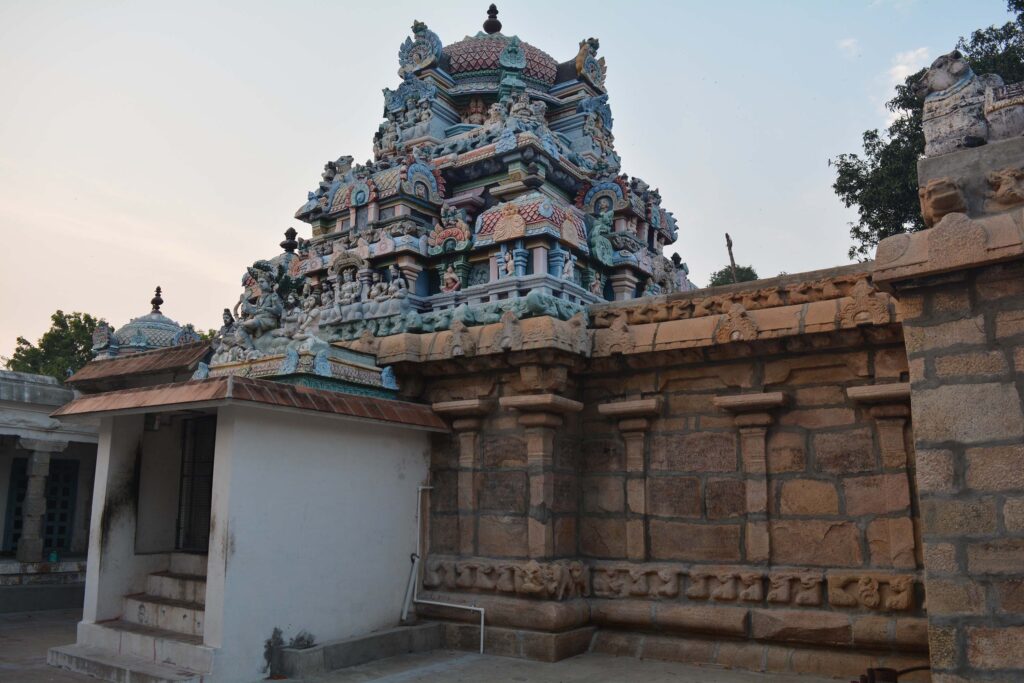
The pilasters cantoning the wall are brahmakantha and has the head components of kattu, kalasa, tadi, kumbha, pali, phalaka, virakantha. Some of the pilasters possess mala, sthana, and miniatures in the mala section. The potikas are angular-taranga with kuzhavu and median patta. The kuzhavu is formed in the angular point and the patta is ornamented with scrolls. The potikas extend its limbs to bear the uttira, the potikas are three limbed at corners. Above the uttira is the vajana and valabhi, the valabhi is adorned with bhuta frieze. The roof of the tala extends as a flexed and overhanging kapota, ornamented with kudus at frequent intervals and chandramandalas at the ridges, konapattas at the corners and middle. The kudu arches have flowery ornamentation at the top, the hangings from the flowers are shown as scrolls, and the kudus formed in the center are adorned with gandharva heads. Bhumidesa represented with yazhi frieze and makara heads in the corners is shown above the roof of the aditala. The bhadra section is adorned with a koshtha on the west, north and south.
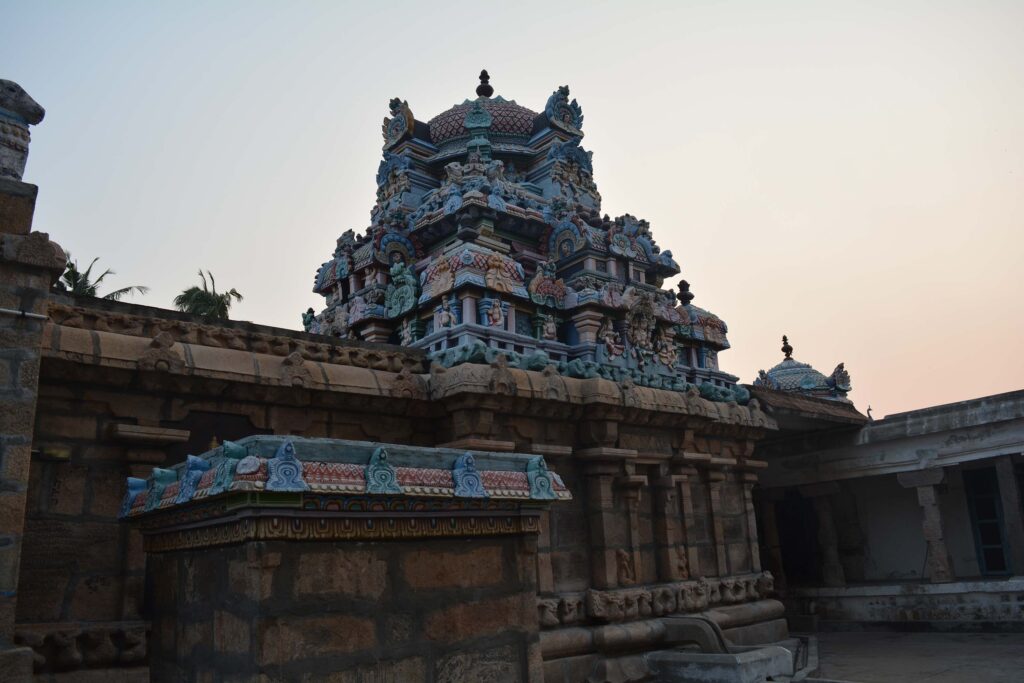
The koshthas are tall and have a pair of brahmakantha split pilasters ornamented with the head components of kalasa, tadi, kumbha, pali, phalaka and virakantha. Angular potikas rest above the pilasters bearing the uttira followed by vajana. Instead of arched thorana a rectangular throrana is crowning the koshthas on all the sides. For all the koshthas on either side in the mother wall rishis or deities are shown. Lord Dakshinamurti adorn the the southern koshtha is
The entire super structure is refurbished with cement plastering and painting. Karnakutas and bhadrasalas form the hara elements, interconnected by the harantara. A vedika complex spread for the hara elements as a common basement, the karnakutas have the griva and sikhara over it, whereas a tala is shown above the vedika complex for the bhadrasalas and crowned with sala sikhara. A pair of brahmakantha pilasters at corners are shown and also adorned with a koshtha in the middle. The bhadra sala is crowned with sala sikhara. The griva of both bhadrasalas and karnakutas are cantoned by a pair of brahmakantha pilasters on each side with alpa nasika in the middle. Thus the bhadrasalas are shown as dvitala salas. The harantara is also decked with kshudra nasikas, the kshudra nasikas are represented with a pair of pilasters and crowned with kirtimukhas. Except the nasikas of the sala the rest of the nasikas are adorned with stucco figures damsels, rishis, devas, ganas etc. The koshthas in the bhadrasalas are decked with the prime deities and their consorts; Brahma with his consorts on the north, Dakshinamurthy on the south, Vishnu with his consorts on the west and Siva with his consorts on the east.
Since an arpita hara, the harmaya of the second tala is raised adjoining the hara of the aditala. The second tala is cantoned by four brahmakantha pilasters on each side, the pilasters are decorated with head components, it is quite interesting to see a big phalaka for the pilasters. The potikas resting above the pilasters are angular and bear the prastara of the tala. The valabhi is adorned with bhuta frieze and the kapota is ornamented with kudu arches, konapattas and chandramandalas. The bhumidesa above the tala is represented with yazhi frieze and makara heads. On the roof of the talas in the corners a pair of Nandi is shown with a gana in anjali hasta in the middle.
The vesara griva of the sikhara rests on the octagonal shape vedika complex. The wall of the griva is adorned with Dikpalas. The cardinal directions are shown with koshthas and the sub-cardinal directions with kshudra nasikas, both much projected out of the griva and sikhara. The griva koshthas are adorned with deities of cardinal directions whereas, the kshudra nasikas with rishis. The vesara sikhara is ornamented with diagonal patterns in the body, chandramandalas at the ridges, padma in the apex and a metal stupi adorning the apex.
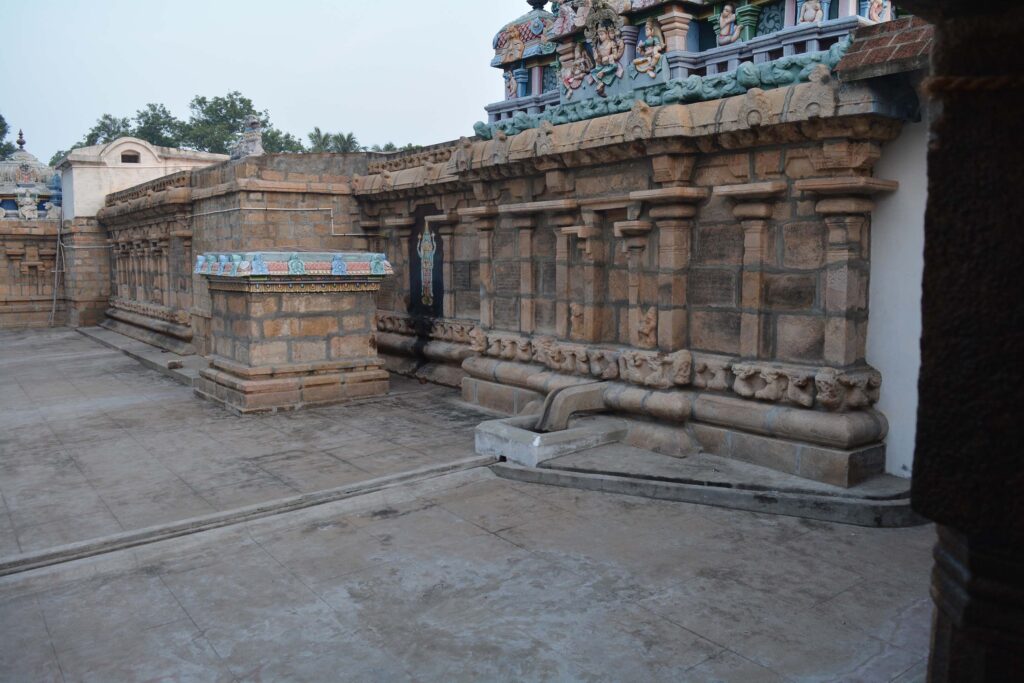
The mukha mandapa extending adjoining the vimana in the east carry the same features of the vimana viz., pratibandha adhishthana, bhitti and prastara. Vargabedha and the sala projection seen in the vimana are absent besides, the jagati is fully formed as padma jagati. The bhitti is cantoned by four brahmakantha pilasters carrying the same features of the pilasters of the vimana. Taranga-kuzhavu potikas are seen on the northern side whereas on the southern side they are simply angular. All the usual prastara elements are seen. The bhuta frieze shown on the valabhi of the vimana also runs for the valabhi of the mandapa. The roof of the mandapa extends as flexed over hanging kapota on the north and south and decked with kudu arches. The bhumidesa of the vimana also continues for the mukha mandapa.
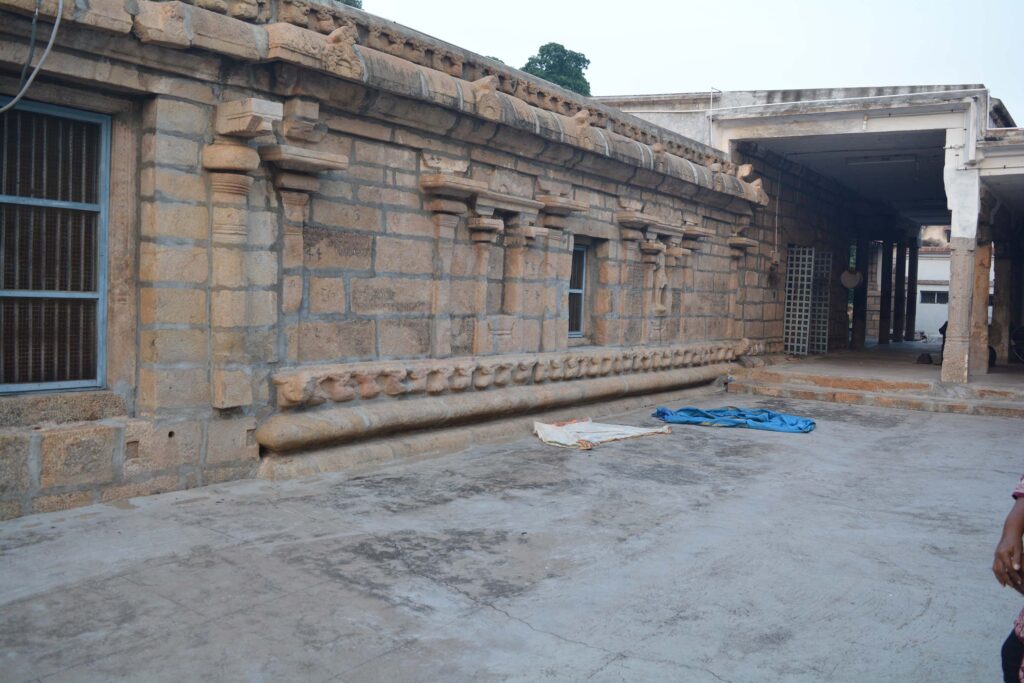
The maha mandapa that extends in front of the mukha mandapa has an adhishthana, bhitti, prastara. The adhishthana is pratibandha type, with padma jagati, vrtta kumuda, prati series. The bhitti is cantoned by six brahmakantha pilasters; with head components of kalasa, tadi, kumbha, pali, phalaka and virakantha. The potikas are angular taranga with kuzhavu, it is quite interesting to see the kuzhavu is formed in the middle of the angular section. The potikas bear the uttira. The uttira is followed by vajana and valabhi, the valabhi is plain. The flexed overhanging kapota is adorned with kudu arches. Above the roof of the mandapa is seen the bhumidesa represented with yazhi frieze. It is to note that the pillars and potikas of the mandapa inside differ from that of the same in the bhitti of the mandapa. However, a pair of pilasters flanking the southern doorway of the mandapa possesses the same features of the pillars inside.
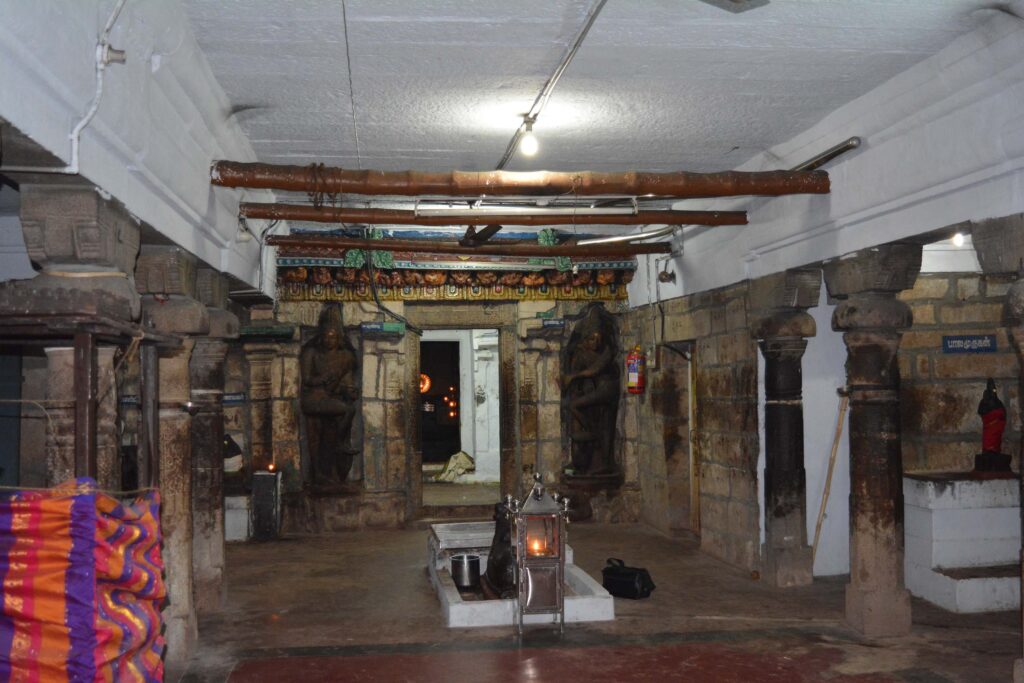
On the southern side of the maha mandapa, a window is seen in between the middle two pilasters whereas on either side between the pilasters niches are seen, Lord Siva in standing posture is housed in the eastern niche, the western niche is empty. On the northern side, the space between the middle pilasters are adorned with niches, all the three niches are empty. The niches on both sides are flanked by the brahmakantha split pilasters, the pilasters possess the same features of the pilasters of the mother wall and crowned by plain thorana. Besides, in all the niches a padma pitha is seen. In between the mukha mandapa and the maha mandapa an interconnecting construction is seen, it consists of plain wall without proper features of a tala, probably the idainazhigai might have been renovated as a closed enclosure.
Inside the maha mandapa is a pillared hall with two rows of pillars in the middle and a row of pillars near the wall of the mandapa on either side. In middle rows seven pillars are seen in each, the pillars has oma, the shaft raising on the oma is ornamented as vishnukantha, indrakantha and rudrakantha consecutively, the head components kattu, kalasa, tadi, kumbha are shown in the rudrakantha section. It is quite interesting to see the pali and phalaka are absent in all the pillars. The pilasters adjoining the walls are three squares with kattu in between. The potikas resting above the pillars are vettu with taranga and kuzhavu ornamentation. The sides are ornamented as frames, the tarangas are shown on either side of the tenon, the base has three tarangas, kuzhavu is formed in the angular point and continued by two tarangas then a petal like ornamentation is shown. It is quite interesting to see kuzhavu and elongated taranga in the tenon potika.
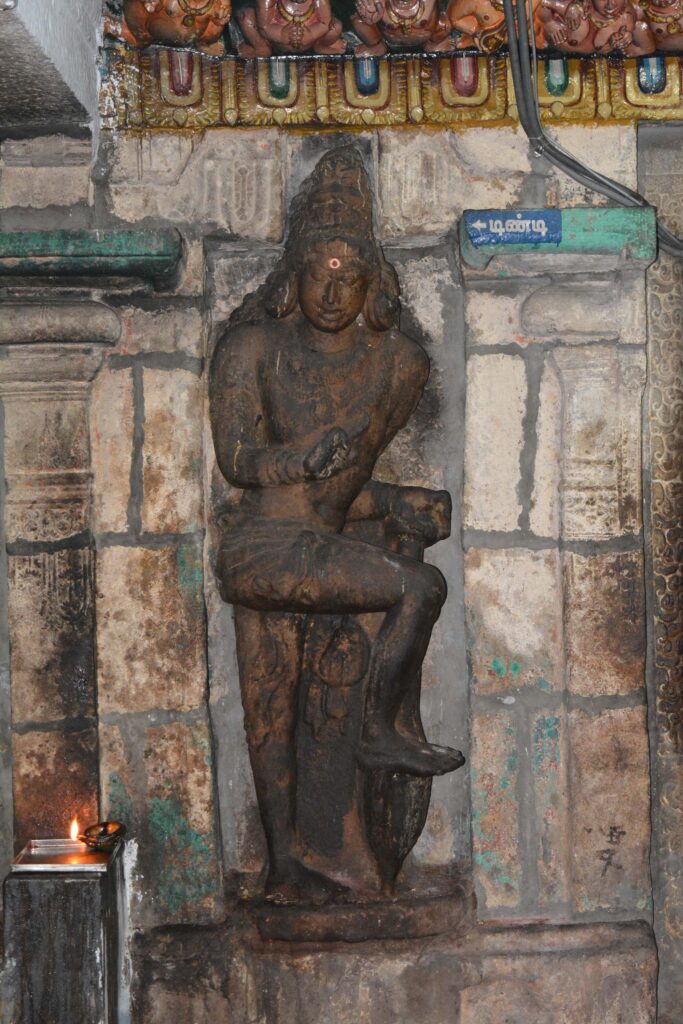
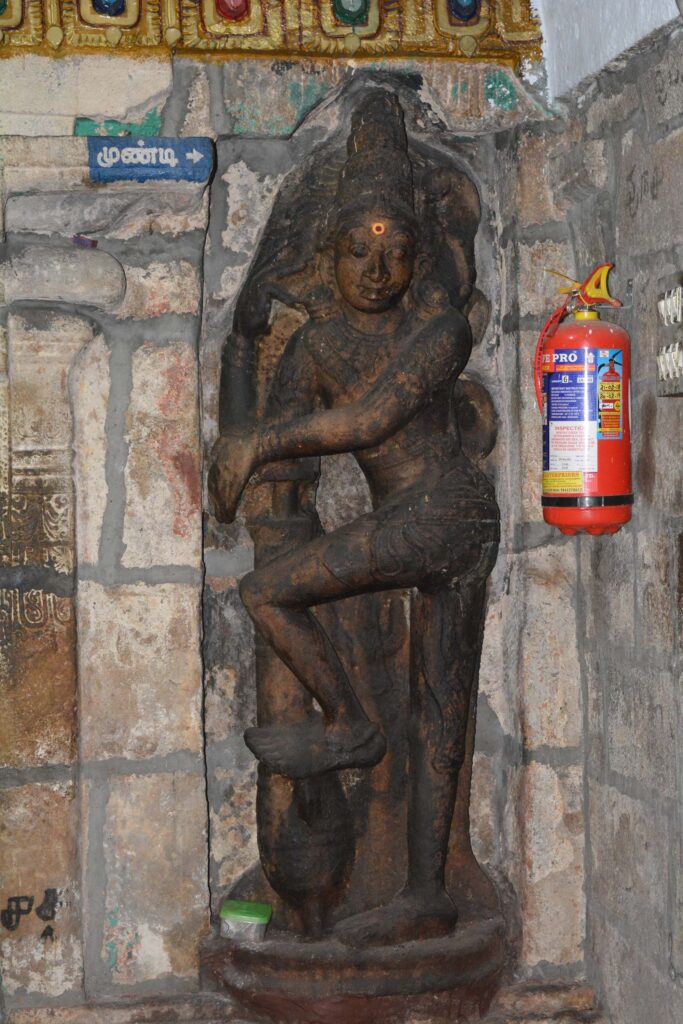
On the north western and south western corners of the maha mandapa chambers are formed, Ganesa, Santhanakrishnan, Uthanga maharishi, Jyesta are seen in the latter. Bairava, Surya and Chandra are seen placed on a platform formed adjoining the north eastern corner, as like, Balamuruga is found placed on a platform formed adjoining the northwestern chamber. The maha mandapa leads to the mukha mandapa. The anterior wall of the mukha mandapa possesses the same features as found in the northern and southern side of the mandapa. The bhitti is cantoned by four brahmakantha pilasters with same ornamentation. The doorway to the mukha mandapa is formed in between the middle pilasters whereas on either side niches are formed and Dvarapalas are housed in. The jambs and lintel of the door frame is ornamented with lush creeprs and the lintel is parted as gala and pada, the padas adorned with miniatures of Nandi. The mukha mandapa is pillar-less chamber, however, angular-taranga-kuzhavu potikas are seen. It is quite interesting to see potikas formed in the cross running prastara of the mukha mandapa. The mukha mandapa leads to the sanctum a cubical chamber housing Lord Siva in the form of Linga and in the name Mahadeva of Thiruvadakudi.
The shrine of Chandeswara is on the northern side of the prakara. The shrine has an adhishthana, bhitti cantoned by four plain brahmakantha pilasters, prastara, however, griva and sikhara are absent. The padabandha adhishthana has octagonal kumuda, the potikas are angular and plain, prastara is refurbished with cement finishing and painting. Chandeswara is seated in suhasana on a pedestal with his left hand resting on his thigh and the right hand carrying parasu.
Continue…