RAVANA’S HUMILIATING DEFEAT UNDER VALI
Thiruvidaimaruthur a town panchayat and headquarters of Thiruvidaimaruthur taluk is an important pilgrim center of Kumbakonam region, about 9kms from Kumbakonam and 38kms from the district headquarters Thanjavur. The place is renowned for Mahalingaswami temple, a padalpetra sthalam and also one among the Thiruneelakkudi Saptasthanam. The place and temple is also associated with Pattinatthar, it is said that he resided here for sometimes. It is quite interesting, while Thiruvarur get the sobriquet for Therazhagu, Thiruvidaimaruthur is referred for teruvazhagu.
Mahalingeswara temple is a huge three prakara complex with gopuras, mandapas, and various sub-shrines. The Lord of the temple is known as Mahalingaswami and the Goddess Bruhatsundarakuchambika and Mookambigai. A shrine for Goddess Mookambigai constructed in North Indian style is seen in this complex. Nearly hundred and fifty inscriptions are found in this temple complex belonging to various dynasties that ruled Tamil Nadu viz., Pandyas, Cholas, Vijayanagar, Nayaks, Marathas, shows the continuous patronization under various dynasties.
A mandapa that lies in the outer prakara that function as temple office at present, is a huge pillared hall. The frontage of the mandapa has five rows of four pillars each, that leads to the colonnade like passage where two rows of pillars and pilasters are seen, at the rear side of the mandapa, stage is seen. The massive pillars in this mandapa are ornamented as three squares and kattu, lower squares are decked with nagabandhas in the corners, besides, padma-kattu is shown in between square and kattu. The faces of the squares are adorned with miniatures. Miniatures depicting Gods, Goddess, themes in puranas, ramayana, dancing scenes, other social scenes are seen. The potikas resting above the pillars are maddalas and the nanudal is ornamental as padma with a small bud in the tip.
Ramayana as narrative series is seen in Early Chola temples, especially introduced by Parantaka Chola I as kantha-pada sculptures, landmark scenes from each kandam were depicted. Among the Ramayana scenes Vali-Sugriva scuffle with interlocking legs and hands like wrestlers, Ravana-anugraha are quite commonly seen in temples of Tamil Nadu. It is quite interesting and rare to see two of the miniatures in this mandapa depicting the humiliating defeat of Ravana.
Valmiki Ramayana in 36th canto speaks the Ravana’s humiliation at the hands of Vali and Ravana then makes friendship with him. Ravana, the lord of Ogres, ranged over the globe, approached whomsoever he heard as superior, challenged him for a duel. On his way he reached the city of Kiskindha, ruled over by Vali, he then challenged Vali. Tara, Susena, Angada and Sugriva who were present there informed that Vali has gone out to do his sandhya prayers on the shore of four oceans and will be returning in an hour. They cautioned Ravana not to combat with mighty Vali, the moment he encounters there comes his end, or if he was in a hurry to lose his life can proceed to south sea. Ravana flew to southern sea in his pushpaka vimana, on seeing Vali he alighted the vimana and behold of Vali who resembles like a mountain of gold. Ravana silently proceeded to capture Vali, however Vali remained unperturbed. Vali uttered to himself that pressing in his arm-pit he shall visit the three oceans and see the enemy Ravana hanging from his arm-pit with his thighs, hands, raiment dangling like a serpent in the claws of Garuda. Then having captured Ravana, pressing him in his arm-pit, Vali sprang up into the air in high speed as like the wind that sweep away the clouds. Vali in extraordinary speed one after another reached the four seas in four directions, plunged, said prayers in each sea. Ministers of Ravana rushed upon Vali to secure him. After saying the Sandya prayers in all the four seas returned to Kiskindha. He landed in a park adjoining Kiskindha and disengaged Ravana from his arm pit, questioned Ravana whence are you? Ravana explained that he came to encounter with him, but was astound of the strength, prowess, and profundity in Vali and called Vali as Jewel among Monkeys. Instead of combat, Ravana requested for enduring friendship with Vali and in front of fire they entered into fraternity by embracing each other. With their hands clasped together, the two warriors entered Kiskindha as lion entering the cavern. Ravana spent a month with him as like Sugriva.
In Ottakuthar’s Uttarakandam, Ravana, the lord of Ogres, on his way reached Kiskintha that was ruled by Vali and he enquired about the availability of Vali. Tara, the wife of Vali questioned Ravana, why like a phantom he came in the night. Ravana replied, he want to combat with Vali to prove his might to world. Tara cautioned Ravana that he will lose his life and showed him the mountain in front, is heap of bone, the remains of Thunthumi who died at the hands of Vali. But Ravana was stubborn, Tara informed that Vali will come after completing his Sivapuja in the four Seas, warned him to stop his ruckus, if wanted can meet him immediately in the South sea.
Ravana reached the South Sea where Vali was doing his Sivapuja. Vali, the warrior who skimmed the parkadal was in Sivapuja with his eyes closed, he was like mount Meru, glowing like a sun. Ravana planned to capture Vali approaching silently from back. Vali recognized Ravana is at the back to capture him but unperturbed continued with his puja. Ravana, as like a cheetah pouncing on its prey reached Vali and hold him tightly with his twenty hands. Vali with two arms hold Ravana as like crushing his bones and swiftly tied him in his tail. After completing his Siva puja in the South Sea he fled to West Sea, Ravana was dangling in his tail like a snake at the claws of eagle. Mountains and trees on the way were uprooted and dragged forward to the speed of Vali. Ministers of Ravana were running behind Vali to retrieve Ravana, but all went vain. Vali then in rapid speed proceeded to the Northern Sea, then reached the black sea in the eastern side and did his Siva puja. After completing his Sivapuja finally reached Kiskintha, the city decorated with beads.
Tara was happy seeing Vali and find Ravana tied and hung from his tail. She pitied on seeing the pain of Ravana and asked Vali to free Ravana. As Vali was completely immersed in prayers, failed to enquire about Ravana’s purpose of visit, Ravana explained that he came to combat with him instead was caught. Vali invited Ravana for war, but Ravana denied as he was tiered and painful as tied in the tail. Instead Ravana requested for friendship with Vali. Vali took Ravana to his palace and asked him to spend a month with him and declared him as his friend.
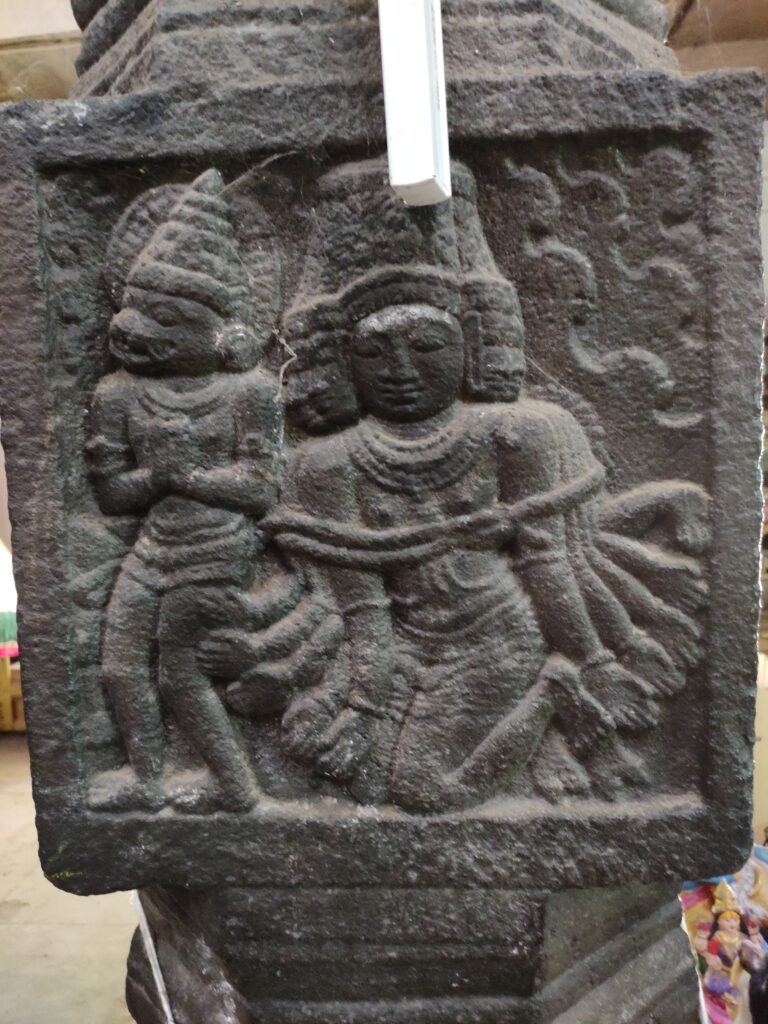
In Mahalingaswami temple, the humiliating defeat of Ravana by Vali is depicted in the middle square in one of the pillar on the left side proper of the mandapa. The panel is framed with square border, two figures are shown inside with clouds in the backdrop; a monkey faced figure and to his left is a multi-headed cum arms figure. The monkey faced figure is in Anjali hasta, while the multi-headed cum arms figure is fastened by rope and seems like kneeling in posture. The tied and kneeling posture denotes as subdued. The monkey faced figure standing in Anjali hasta is Vali in his prayers while the multi-headed cum arms figure is Ravana, shown as tied and subdued, probably the rope might be the tail of Vali.
Upon their attire and ornaments; only five heads of Ravana are visible and all the heads are decked with kirita-makuta. Totally ten arms are shown, five on each side and decked with kankanas and bhujanga valaya. The attire is a short drapery, fastened by hip belt, besides, idaikattu is slackly worn above it. Ears are elongated lobes but remain plain. Kandigai, charapali, stone studded mala adorns the neck, chhannavira in the chest and thazhseri in the ankle are the ornaments adorn by him. Tholmalai is seen in the shoulders. His expression in the faces, dangling hands, kneeling like posture shows his subjugation.
Vali standing to the right of Ravana is in anjali hasta, decked in karanta-makuta, with siraschakra. Patrakundala, charapali, kankanas, keyura and bhujanga valaya are the ornaments adorned by him. Short attire extending upto thighs drape his lower body, idaikattu is slackly worn above it, for which knot is seen on the right. Besides, megalai is worn above the attire. Vali in Anjali hasta, mouth slightly open with his sharp canine teeth extending outside, shows his fierce mood.
As per the Valmiki version of Ramayana, Ravana was held in the armpit by Vali speeded up in four directions. But, Mahalingaswami temple mandapa miniature shows Ravana is fastened in the rope, perhaps the tail of Vali. Likewise, conspicuous variation in narration are seen in both the literature, Tara’s father replied when Ravana questioned Vali’s availability in the Valmiki version, but Tara herself answered in Ottakuttar version, Vali is mentioned as doing Sandhyavadhana in former whereas Sivapuja in later, Vali landed in a park and enquired the visit of Ravana in the former version but in the latter version Tara requested Vali to relieve Ravana as saw him suffering in pain. Accordingly, the miniature found in the mandapa of Mahalingaswami temple, Ravana fastened in the tail of Vali, nevertheless, the Ottakuttar version of Ramayana.