THIRUVALANJUZHI KSHETRAPALA
Lord Kshetra-pala, the name itself suggests Him a protector of land; the protector of fields, region, sacred places, and also against evil. In nude form with snakes entwining the body, locks arranged as flames, fangs ejected, eyes spewed out, arms carrying protective weapons, exhibits the fierceness of the deity. Ksetrapala is considered synonym with Bhairava, however, puranas speak different version of stories associated with them, Bhairava is said to be one of the samhara form of Lord Siva particularly appears as Brahma-siraschchetakamurti, and Ksetrapala is said to be created to annihilate Daksha, He accompanied Virabhadra in the campaign against Daksha.
Lord Bhairava is quite popular form of worship, widely prevalent in Tamil region, found in Siva temples in the north-eastern side facing west, in some places housed in separate shrine in the above said direction. The deity is commonly shown with two or two pair of arms however four pairs of arms also seen; kapala, sula, damaru, snake, pasa, sword are the prime objects held by the God in the arms. In attributes, Lord Kshetrapala resembles Lord Bhairava, however, the ferocious dog is absent, further, bow and arrow the prominent weapon of Kshetrapala is not shown for Bhairava. Above all Kshetrapala is rarely seen.
The prominence of Kshetrapala worship is conspicuous during Chola period, especially Rajaraja Chola I. It is remarkable to mention that a separate shrine for Kshetrapala was first constructed by Dantisakthividangi alias Lokamadevi, the chief queen of Rajaraja Chola I at Thiruvalanjuzhi Nathar temple at Thiruvalanjuzhi in Thanjavur district. The shrine is on the south-eastern side of the temple complex in the outer prakara facing west. In addition, innumerable inscriptions in the Kshetrapala shrine records the rich endowments made by the queen and other members of royal family in the form of ornaments, gold, land, paddy, cash for various services for the deity. All these denotes the significance of Kshetrapala worship during Chola period. The Kshetrapala consecrated by Queen Dantisaktividangi is a masterpiece of sculptural art.
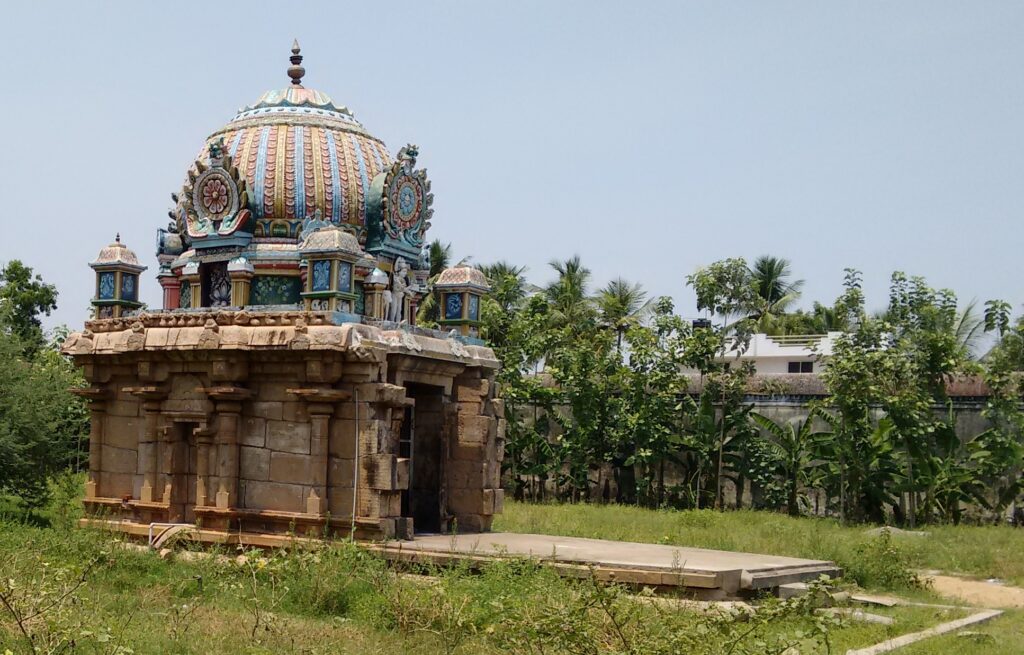
The Kshetrapala temple constructed by Queen Dantisakthividangi alias Lokamadevi is in the outer prakara of the Thiruvalanjuzhi nathar temple in the south-eastern side of the temple complex. The shrine consists of vimana and mukha-mandapa, however, for the later only the adhishthana alone remains the rest are dilapidated. The vimana is an ekatala vimana misra vesara vimana. The Kshetrapala consecrated by the Queen is not found in the temple, however, kept in the Rajaraja Chola palace museum in Thanjavur.
THIRUVALANJUZHI KSHETRAPALA
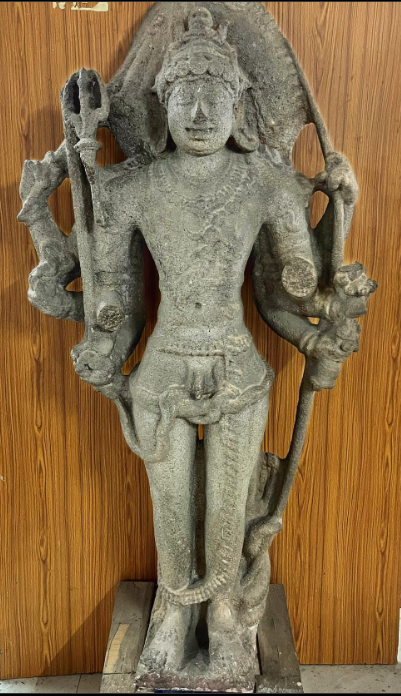
Lord Kshetrapala is standing in sama on a pitha in nude posture, the locks are arranged as sudarmudi and decked with stone studded head-patta, and decorated with crescent moon in the left, scull in the middle flanked by snakes with hood raised. The God is shown with eight arms, four on each side, the front pair of arms are broken and the rest of the arms are in kataka and carry objects; the remnant trident seen on the right side denotes the front right hand holds trident. The back hands on the right carry long sword, pasa and arrow from bottom to top. It is quite interesting to see that the arrow held by the God in the back most hand is with trident edge. As like, the back hands on the left carry bell, damaru and bow in the order spreading from bottom to the top. The bow held by the God in the back most left hand is long, extending from foot to head, it extends adjoining the sudarmudi. The ears are elongated and decked with owl-kundala in the left and snake-kundala in the right, kandigai, a long beaded mala, stone studded charapali adorns the neck, keyura and kankanas in the arms, stone studded udarabanda adorns the abdomen, stone and beaded hip ornament wound the waist, as like stone and beaded thazhseri bejewel the ankle. Yajnopavita is a scull garland, in that the sthanasutra splits and extend in upavitha fashion while the uras-sutra stringed as a bell garland extends upto the ankle. A snake is seen entwining below the waist, coiling around the thigh with raised hood on the right thigh. Another snake is seen near the left foot coiling the long bow held by the God to His left. The broad smile of the God not only makes the sharp fangs conspicuous but also the beauty of the God.
The deity in slender stature, the four pair of arms decked with weapons and objects, a broad smile with fangs ejected and eyes spewed out shows a grand portrayal of Lord Kshetrapala. Nevertheless, the Kshetrapala of Thiruvalanjuzhi at Rajara site Museum, Thanjavur is a masterpiece of sculptural art.
Continue….